
How to Answer Meta PM Interview Questions: The Growth Accounting Framework
Learn how Meta evaluates PM candidates differently from other tech companies. Master the Growth Accounting framework and company-specific thinking that interviewers expect.
Every day, 2.9 billion people use Meta's apps. When you walk into a Meta PM interview, generic frameworks won't cut it. Here's why — and what to do instead.
The Problem with Generic PM Frameworks
Most PM candidates prepare using the same playbook:
- AARRR pirate metrics
- CIRCLES method
- SWOT analysis
- Generic user personas
The result? You sound exactly like every other candidate.
Meta interviewers aren't looking for textbook answers. They're looking for evidence that you think like a Meta PM.
What Makes Meta Different?
Meta's business model is fundamentally different from Google, Amazon, or Apple:
- No transactions: Unlike Amazon, users don't buy anything
- Attention-based: Success = time spent, not conversion rates
- Network effects: Value grows exponentially with users
- Viral growth: Products spread user-to-user organically
This means Meta PMs need a different mental model.
The Growth Accounting Framework
Meta invented Growth Accounting to measure what actually matters for their business. Here's how it works:
The Formula
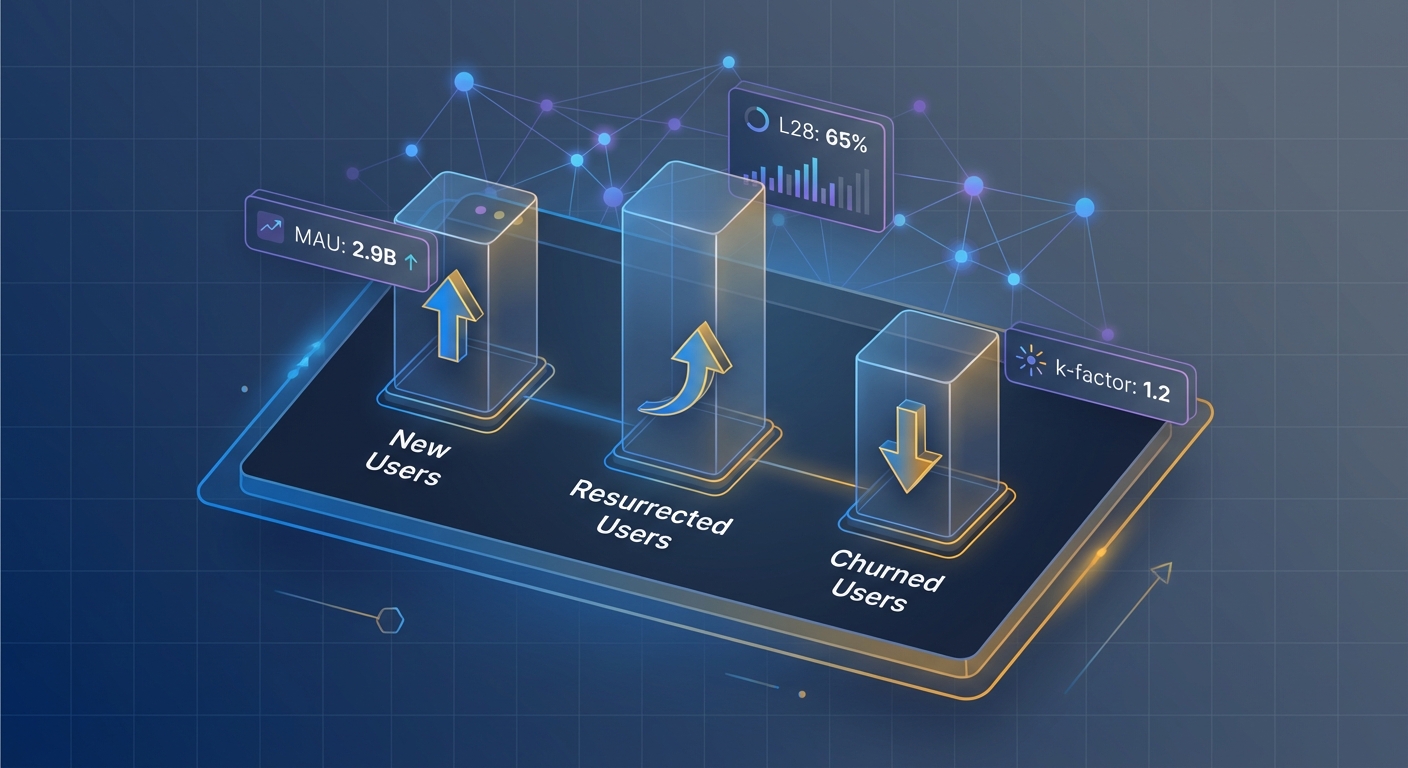
MAU (Month 2) = MAU (Month 1) + New Users + Resurrected Users - Churned Users
Where:
- New Users: First-time users this month
- Resurrected Users: Previously churned users who returned
- Churned Users: Active users who stopped using the product
Why This Matters
Unlike AARRR (Acquisition, Activation, Retention, Revenue, Referral), Growth Accounting focuses on user lifecycle states rather than funnel stages.
Example Question:
"Instagram Reels DAU dropped 10% last week. What happened?"
Bad Answer (Generic):
"I'd check the funnel. Maybe acquisition dropped, or retention decreased. Let me run A/B tests..."
Good Answer (Meta-Specific):
"Let me decompose this using Growth Accounting. A 10% DAU drop could come from three sources:
- New user drop: Did we lose a growth channel? (Check: referrals, app store ranking, viral loops)
- Resurrection drop: Are fewer churned users coming back? (Check: notifications, re-engagement campaigns)
- Churn spike: Are more active users leaving? (Check: recent product changes, competitor launches, content quality issues)
I'd start by segmenting the drop by user cohort. If it's concentrated in new users, it's a top-of-funnel issue. If it's across all cohorts, likely a product quality problem..."
See the difference? The second answer shows you understand how Meta thinks about growth.
Other Meta-Specific Frameworks You Must Know
1. L28 (28-Day Active Users)
Meta doesn't just track DAU (Daily Active Users) or MAU (Monthly Active Users). They invented L28: users who were active on at least one day in the last 28 days.
Why? L28 is more stable than DAU (less noisy) but more granular than MAU (catches recent trends faster).
2. Network Density
Formula: (Actual Connections) / (Possible Connections)
Meta cares deeply about how connected the network is. A social network with many isolated clusters is less valuable than one with dense interconnections.
3. Viral Coefficient (k-factor)
k = (# of invites sent per user) × (% conversion rate of invites)
If k > 1, the product grows exponentially through virality alone. Meta products aim for high k-factors because they don't rely on paid acquisition.
How to Apply This in Interviews
Before the Interview
- Practice with Meta-specific questions on Zobhe
- Replace "conversion rate" with "growth accounting" in your answers
- Think about network effects first, individual users second
During the Interview
Always start with:
"At Meta, I'd approach this through the lens of network effects and growth accounting..."
Mention these concepts naturally:
- "How does this feature improve network density?"
- "What's the viral coefficient we expect?"
- "How does this move the L28 metric?"
Example: Redesign Facebook Groups
Generic Answer:
"I'd improve the UI, add better search, and make it easier to join groups."
Meta-Specific Answer:
"Facebook Groups is a network density play. Right now, most users are in 1-2 groups (low engagement). The goal is to increase average groups per user to 5+.
Growth Accounting Lens:
- New Users: Improve group discovery (recommendations, friend-based suggestions)
- Resurrection: Re-engage dormant group members (notification triggers, content highlights)
- Churn Reduction: Improve group quality (better moderation tools, relevance ranking)
Network Effects:
- Each new group member makes the group more valuable for existing members
- More active groups → more invites sent → higher k-factor → viral growth
Metrics:
- Primary: L28 Groups (users active in groups in last 28 days)
- Secondary: Average groups per user, group network density
- North Star: Daily time spent in groups (attention metric)"
Common Mistakes to Avoid
❌ Mistake 1: Talking About Revenue First
Meta makes money from ads, but PMs focus on user value first. Revenue is a lagging indicator of engagement.
Wrong: "This feature will increase ad clicks by 10%..."
Right: "This feature will increase time spent, which naturally drives ad impressions..."
❌ Mistake 2: Ignoring Network Effects
Meta products are valuable because of other users, not features.
Wrong: "Users will love this new filter..."
Right: "This filter encourages sharing to Stories, which increases friend connections and network density..."
❌ Mistake 3: Using Google/Amazon Frameworks
Don't talk about "conversion funnels" (Amazon) or "search relevance" (Google) unless directly relevant.
Use Meta language:
- Growth Accounting (not AARRR)
- Network effects (not product features)
- L28 (not MAU)
- Viral coefficient (not acquisition cost)
Ready to Practice?
The difference between a generic answer and a Meta-specific answer can make or break your interview.
Try this:
Go to Zobhe and practice answering Meta PM questions. Our AI is trained on 40KB+ of Meta-specific frameworks, including:
- Growth Accounting decomposition
- Network effects analysis
- Meta's cultural values (Move Fast, Be Bold, Build Social Value)
- Real Meta interview questions with company-specific rubrics
Example questions to try:
- "How would you improve Instagram Stories engagement?"
- "Design a crisis management app for Meta"
- "Facebook DAU dropped 5%. What do you do?"
Each answer is scored against Meta's actual evaluation criteria — not generic PM frameworks.
Key Takeaways
- Meta cares about growth, not transactions. Use Growth Accounting, not AARRR.
- Network effects are everything. Always consider how features impact connections between users.
- Speak Meta's language. Use L28, k-factor, network density in your answers.
- Practice with company-specific prompts. Generic ChatGPT answers won't prepare you for Meta's unique evaluation style.
Next Steps:
- Generate a Meta PM answer on Zobhe
- Read: The Complete Guide to 13 PM Interview Question Types
- Compare: Google vs Meta PM Interviews: What's Different? (coming soon)
Want to see how your answers stack up? Try Zobhe for free and get company-specific feedback in seconds.
Ready to Practice?
Generate company-specific PM interview answers using Zobhe. Free forever.
Try Zobhe Now